

Before the first meal of the day is cooked in many rural homes, there is often a question that quietly hangs in the air: What will we eat today?
For some elderly Nigerians, the question has become a familiar part of growing old.
In rural communities scattered across Lagos and Ogun states, age has not always come with the comfort many imagine. For men and women who spent their younger years raising families, working the land, trading, building homes and contributing to their communities, old age can bring a cruel combination of declining strength, shrinking income and increasing dependence.
It is against this backdrop that Ben Edem is taking food to the elderly.
Through the Local Food Bank for the Elderly, an initiative under the Rural Food Bank Support Foundation, Edem is leading a humanitarian support project aimed at reaching vulnerable elderly people in rural communities with food supplies.
The ambition is striking: 10,000 vulnerable elders every month.
It is a target that transforms what might ordinarily be seen as a charitable gesture into a sustained humanitarian intervention.
WHEN HUNGER MEETS OLD AGE
For an elderly person living in a rural community, poverty can be particularly unforgiving.
There may be no regular salary. Pension support may be unavailable or inadequate. Farming, once a source of livelihood, becomes difficult as physical strength declines. Children and relatives who might ordinarily provide support may themselves be struggling with the cost of living.
Then comes the price of food.
A household that once managed to survive on a modest income can suddenly find basic staples beyond its reach.
For an elderly person living alone, the consequences can be devastating.
This is the reality the Local Food Bank for the Elderly is attempting to confront.
Its intervention is built around a basic proposition: old age should not become a sentence to hunger.
TAKING HELP BEYOND THE CITIES
The choice to focus on rural communities is significant.
Lagos is often portrayed through its bustling commercial districts, expanding suburbs and skyline of modern developments. Ogun, too, has experienced rapid economic and population growth.
But beyond the major roads and urban centres are communities where many elderly residents live far removed from the opportunities and services available in the cities.
Some roads leading to these communities are difficult to navigate. Some households are tucked away from the main settlements. For vulnerable elderly people, even travelling to a distribution centre can be a challenge.
That is why the project is taking the support closer to the beneficiaries.
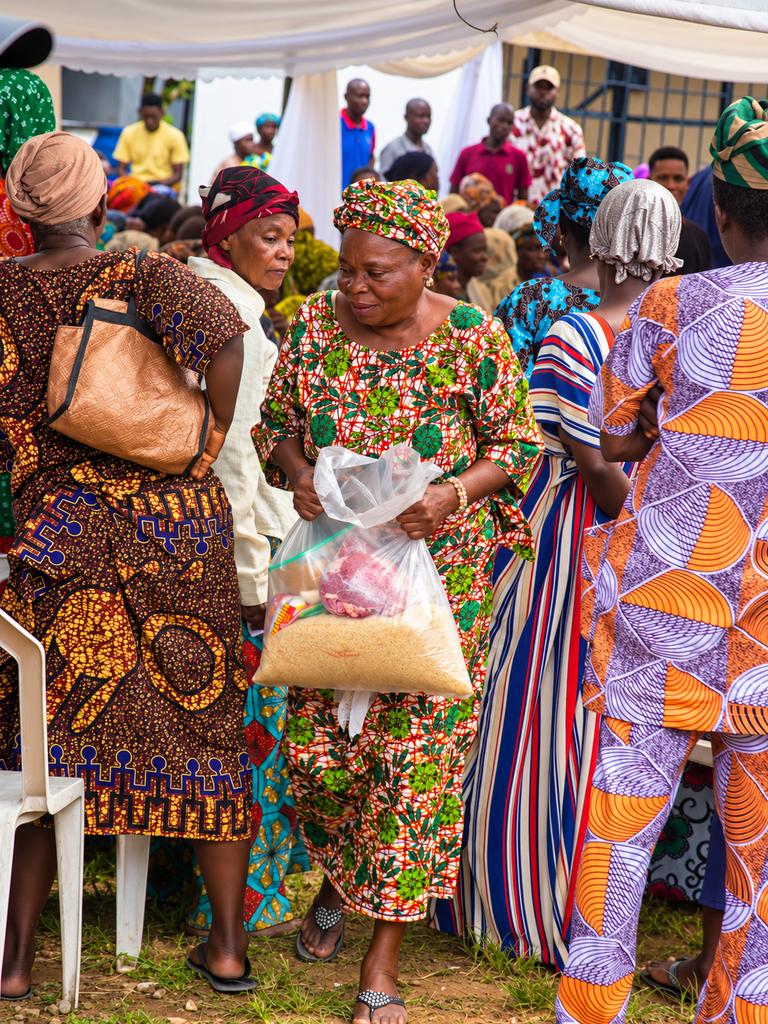
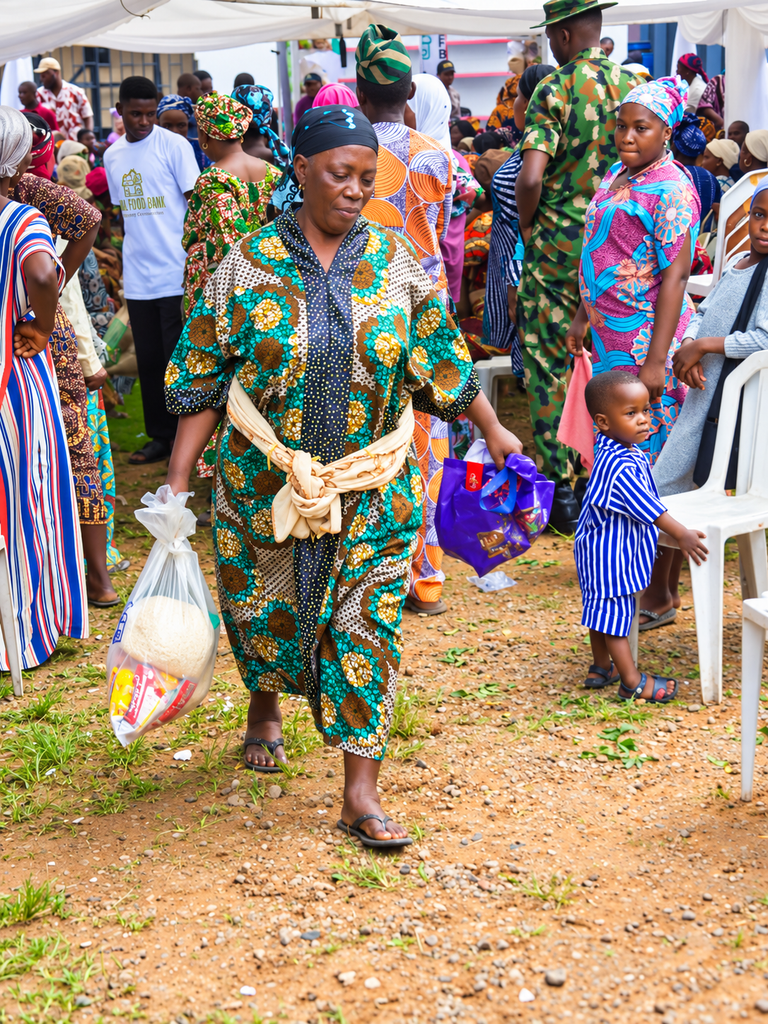
Food items from the Local Food Bank for the Elderly are distributed to vulnerable older people in selected rural communities across Lagos and Ogun states.
The idea is deceptively simple: identify those who need help, mobilise food and take it to them.
But at a scale of 10,000 people every month, simplicity requires organisation.
THE MAN BEHIND THE MISSION
For Ben Edem, the project represents a commitment to making humanitarian support practical and measurable.
Rather than focusing only on the immediate visibility that often accompanies charitable giving, the initiative seeks to establish a regular channel through which food can reach elderly people month after month.
His emphasis on the elderly reflects a population that can sometimes disappear from public conversations about hunger.
Children attract attention because of their vulnerability. Young people dominate conversations about employment and economic opportunity. But elderly people facing food insecurity can remain largely invisible.
They may not have the strength to protest their circumstances.
They may not have access to social media to tell their stories.
And many will simply endure.
Edem’s project seeks to make sure that silence does not translate into neglect.
BEHIND EVERY FOOD IS A PACKAGE STORY
Numbers can make humanitarian work sound clinical.
Ten thousand beneficiaries.
Monthly distributions.
Food items.
Rural communities.
But 10,000 is not simply a number.
It represents 10,000 individual stories.
A grandmother.
A widower.
A retired farmer.
An elderly woman caring for grandchildren.
A man who once provided for an entire household but can no longer work as he did.
A woman whose children have moved away in search of opportunities.
Each beneficiary arrives at the food bank with a different history, but the same immediate need: food.
One of the beneficiaries, mama Adekunle, who lives in Ogun state, has only one child who is bedridden with a terrible sickness. She has explored all avenues to take care of herself, her aged husband who has impaired vision and their sick child.
Putting food on the table becomes a big challenge until she came in contact with Ben Eden humanitarian assistance of providing care and food for her and her family on a daily basis.
That human dimension is perhaps the most important part of the initiative.
Food may be what is delivered, but dignity is what the intervention seeks to restore.
The enormous task of feeding 10,000 every month
There is a vast difference between feeding a few people occasionally and building a programme capable of reaching 10,000 elderly people every month.
The latter requires consistency.
It requires food procurement and storage. It requires transportation and volunteers. It requires community-level identification of beneficiaries. It requires coordination with people who understand the communities and can help ensure that assistance gets to those who genuinely need it.
And above all, it requires sustained support.
A food bank can distribute what it has.
The challenge is ensuring that there is something in the food bank for the next distribution.
This makes the project not simply a humanitarian exercise, but a call for collective responsibility.
Individuals can contribute. Businesses can support. Philanthropists can partner. Community organisations can help identify beneficiaries. Institutions can provide logistics and resources.
The more sustainable the support system becomes, the more elderly people can be reached.
CHARITY WITH A WIDER MESSAGE
There is another message embedded in the project.
How a society treats its elderly says something about its values.
Many of today’s elderly Nigerians spent decades supporting families and communities. They worked when the economy was different, raised children under difficult circumstances and contributed in ways that may never have been formally recorded.
For some, the reward at the end of those working years is not financial security but vulnerability.
The question, therefore, is not simply whether they need food.
It is whether society is prepared to remember them.
The Local Food Bank for the Elderly answers that question through action.
FROM ONE FOOD PARCEL TO MOVEMENT
Ben Edem’s target of feeding 10,000 vulnerable elders every month is ambitious.
But ambitious humanitarian projects often begin with a simple conviction: that something can be done.
In this case, the conviction is that an elderly person should not have to go to bed hungry simply because they live in a rural community, have no regular income or have outlived the people who once supported them.
The Local Food Bank for the Elderly is attempting to create a bridge between those who have resources and those who need them most.
Its work in rural Lagos and Ogun may not always make headlines.
There may be no ribbon-cutting ceremony.
No grand building may carry the project’s name.
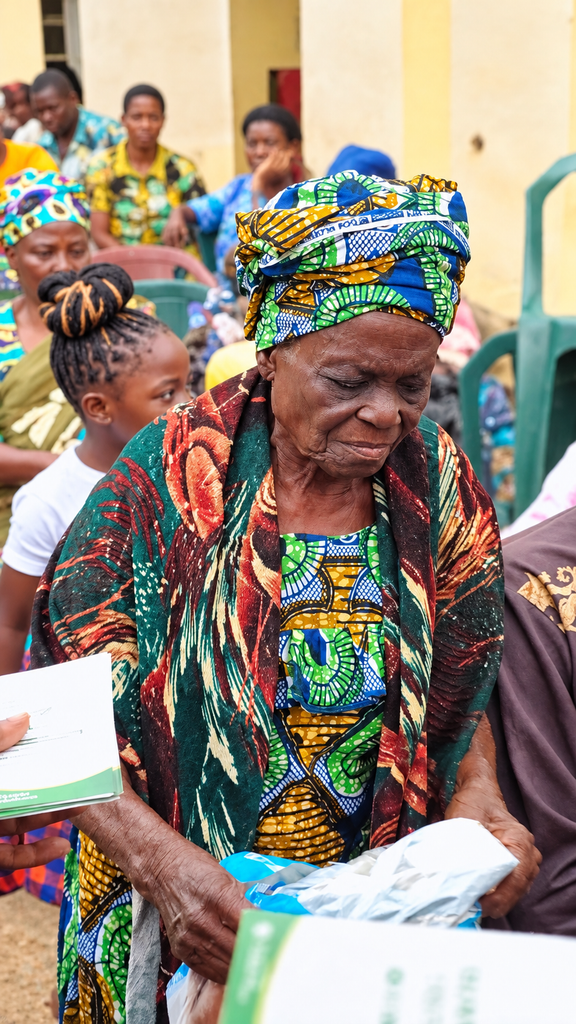
Instead, its impact is likely to be found in quieter moments: an elderly woman opening a food package; a grandfather knowing that his next meal is secure; a family relieved that one more vulnerable member of the household has been supported.
That is where humanitarian work often matters most—not in the spectacle, but in the relief it brings.
A PROMISE TO THE FORGOTTEN
The ambition is straightforward: 10,000 vulnerable elderly people, every month.
The challenge is immense.
But so is the need.
And somewhere in the rural communities of Lagos and Ogun, an elderly man or woman who might otherwise have been forgotten is waiting for the next delivery.
For Ben Edem and the Rural Food Bank Support Foundation, that delivery represents more than food.
It represents recognition.
It represents compassion.
And, perhaps most importantly, it says to an often-overlooked generation: you’re not forgotten
THE LAST MILE OF KINDNESS …Inside Ben Edem’s mission to feed 10,000 vulnerable Elders Monthly!
Before the first meal of the day is cooked in many rural homes, there is often a question that quietly hangs in the air: What will we eat today?
For some elderly Nigerians, the question has become a familiar part of growing old.
In rural communities scattered across Lagos and Ogun states, age has not always come with the comfort many imagine. For men and women who spent their younger years raising families, working the land, trading, building homes and contributing to their communities, old age can bring a cruel combination of declining strength, shrinking income and increasing dependence.
It is against this backdrop that Ben Edem is taking food to the elderly.
Through the Local Food Bank for the Elderly, an initiative under the Rural Food Bank Support Foundation, Edem is leading a humanitarian support project aimed at reaching vulnerable elderly people in rural communities with food supplies.
The ambition is striking: 10,000 vulnerable elders every month.
It is a target that transforms what might ordinarily be seen as a charitable gesture into a sustained humanitarian intervention.
WHEN HUNGER MEETS OLD AGE
For an elderly person living in a rural community, poverty can be particularly unforgiving.
There may be no regular salary. Pension support may be unavailable or inadequate. Farming, once a source of livelihood, becomes difficult as physical strength declines. Children and relatives who might ordinarily provide support may themselves be struggling with the cost of living.
Then comes the price of food.
A household that once managed to survive on a modest income can suddenly find basic staples beyond its reach.
For an elderly person living alone, the consequences can be devastating.
This is the reality the Local Food Bank for the Elderly is attempting to confront.
Its intervention is built around a basic proposition: old age should not become a sentence to hunger.
TAKING HELP BEYOND THE CITIES
The choice to focus on rural communities is significant.
Lagos is often portrayed through its bustling commercial districts, expanding suburbs and skyline of modern developments. Ogun, too, has experienced rapid economic and population growth.
But beyond the major roads and urban centres are communities where many elderly residents live far removed from the opportunities and services available in the cities.
Some roads leading to these communities are difficult to navigate. Some households are tucked away from the main settlements. For vulnerable elderly people, even travelling to a distribution centre can be a challenge.
That is why the project is taking the support closer to the beneficiaries.
Food items from the Local Food Bank for the Elderly are distributed to vulnerable older people in selected rural communities across Lagos and Ogun states.
The idea is deceptively simple: identify those who need help, mobilise food and take it to them.
But at a scale of 10,000 people every month, simplicity requires organisation.
THE MAN BEHIND THE MISSION
For Ben Edem, the project represents a commitment to making humanitarian support practical and measurable.
Rather than focusing only on the immediate visibility that often accompanies charitable giving, the initiative seeks to establish a regular channel through which food can reach elderly people month after month.
His emphasis on the elderly reflects a population that can sometimes disappear from public conversations about hunger.
Children attract attention because of their vulnerability. Young people dominate conversations about employment and economic opportunity. But elderly people facing food insecurity can remain largely invisible.
They may not have the strength to protest their circumstances.
They may not have access to social media to tell their stories.
And many will simply endure.
Edem’s project seeks to make sure that silence does not translate into neglect.
BEHIND EVERY FOOD IS A PACKAGE STORY
Numbers can make humanitarian work sound clinical.
Ten thousand beneficiaries.
Monthly distributions.
Food items.
Rural communities.
But 10,000 is not simply a number.
It represents 10,000 individual stories.
A grandmother.
A widower.
A retired farmer.
An elderly woman caring for grandchildren.
A man who once provided for an entire household but can no longer work as he did.
A woman whose children have moved away in search of opportunities.
Each beneficiary arrives at the food bank with a different history, but the same immediate need: food.
One of the beneficiaries, mama Adekunle, who lives in Ogun state, has only one child who is bedridden with a terrible sickness. She has explored all avenues to take care of herself, her aged husband who has impaired vision and their sick child.
Putting food on the table becomes a big challenge until she came in contact with Ben Eden humanitarian assistance of providing care and food for her and her family on a daily basis.
That human dimension is perhaps the most important part of the initiative.
Food may be what is delivered, but dignity is what the intervention seeks to restore.
The enormous task of feeding 10,000 every month
There is a vast difference between feeding a few people occasionally and building a programme capable of reaching 10,000 elderly people every month.
The latter requires consistency.
It requires food procurement and storage. It requires transportation and volunteers. It requires community-level identification of beneficiaries. It requires coordination with people who understand the communities and can help ensure that assistance gets to those who genuinely need it.
And above all, it requires sustained support.
A food bank can distribute what it has.
The challenge is ensuring that there is something in the food bank for the next distribution.
This makes the project not simply a humanitarian exercise, but a call for collective responsibility.
Individuals can contribute. Businesses can support. Philanthropists can partner. Community organisations can help identify beneficiaries. Institutions can provide logistics and resources.
The more sustainable the support system becomes, the more elderly people can be reached.
CHARITY WITH A WIDER MESSAGE
There is another message embedded in the project.
How a society treats its elderly says something about its values.
Many of today’s elderly Nigerians spent decades supporting families and communities. They worked when the economy was different, raised children under difficult circumstances and contributed in ways that may never have been formally recorded.
For some, the reward at the end of those working years is not financial security but vulnerability.
The question, therefore, is not simply whether they need food.
It is whether society is prepared to remember them.
The Local Food Bank for the Elderly answers that question through action.
FROM ONE FOOD PARCEL TO MOVEMENT
Ben Edem’s target of feeding 10,000 vulnerable elders every month is ambitious.
But ambitious humanitarian projects often begin with a simple conviction: that something can be done.
In this case, the conviction is that an elderly person should not have to go to bed hungry simply because they live in a rural community, have no regular income or have outlived the people who once supported them.
The Local Food Bank for the Elderly is attempting to create a bridge between those who have resources and those who need them most.
Its work in rural Lagos and Ogun may not always make headlines.
There may be no ribbon-cutting ceremony.
No grand building may carry the project’s name.
Instead, its impact is likely to be found in quieter moments: an elderly woman opening a food package; a grandfather knowing that his next meal is secure; a family relieved that one more vulnerable member of the household has been supported.
That is where humanitarian work often matters most—not in the spectacle, but in the relief it brings.
A PROMISE TO THE FORGOTTEN
The ambition is straightforward: 10,000 vulnerable elderly people, every month.
The challenge is immense.
But so is the need.
And somewhere in the rural communities of Lagos and Ogun, an elderly man or woman who might otherwise have been forgotten is waiting for the next delivery.
For Ben Edem and the Rural Food Bank Support Foundation, that delivery represents more than food.
It represents recognition.
It represents compassion.
And, perhaps most importantly, it says to an often-overlooked generation: you’re not forgotten

