
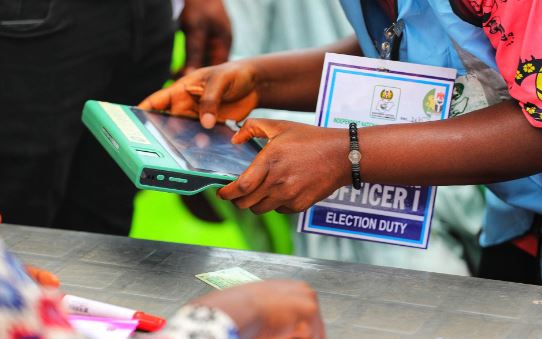

The Independent National Electoral Commission has commenced the 100-day countdown to the 2027 general elections, with Lagos State recording the highest number of registered voters as the North-West geopolitical zone emerged as the most represented region.
The INEC Chairman, Prof. Joash Amupitan, disclosed this on Tuesday at a world press conference in Abuja, where he provided an update on the commission’s preparations for the elections scheduled for January 16 and February 6, 2027.
Amupitan said INEC had completed nine of the 14 critical milestones contained in its revised timetable and schedule of activities for the elections.
He said the commission had translated the statutory timetable into an operational plan covering its headquarters, departments and directorates, 36 state offices, the Federal Capital Territory and offices across the 774 local government areas.The commission’s briefing came as stakeholders, including the police, European Union and National Assembly, pledged support for the electoral body ahead of the polls.
Security, misinformation and the implementation of recent judicial decisions also featured prominently at the meeting.
Lagos leads registerLagos topped the state-by-state breakdown with 7,488,633 registered voters, followed by Kano with 6,570,276 and Kaduna with 4,662,640.
Katsina ranked fourth with 3,876,051 voters, followed by Rivers with 3,736,434, Oyo with 3,588,111, Delta with 3,525,988, Benue with 3,057,225, Ogun with 3,037,981 and Bauchi with 3,012,547.
Ekiti had the lowest number of registered voters at 1,055,708, followed by Bayelsa with 1,200,691.
The Federal Capital Territory recorded 1,732,043 registered voters, while Ondo had 1,733,641 and Gombe 1,768,560.
By geopolitical zones, the North-West led with 25,083,411 registered voters, followed by the South-West with 19,614,274 and North-Central with 16,965,787.
The South-South recorded 15,823,550 voters, while the North-East had 13,965,475 and the South-East 11,976,218.The North-West therefore had 5,469,137 more registered voters than the South-West.
On the demographic profile of the register, Amupitan said male voters numbered 53,528,218, representing 51.75 per cent, while female voters accounted for 49,900,497, or 48.25 per cent.
Voters aged between 35 and 49 constituted the largest age group, with 43,265,946 voters, representing 41.83 per cent of the register.
They were followed by voters aged 18 to 34, who numbered 29,777,576, representing 28.79 per cent.
Those aged 50 to 69 accounted for 22,982,900 voters, or 22.22 per cent, while voters aged 70 and above numbered 7,402,291, representing 7.16 per cent.
The commission recorded 232,658 persons with disabilities across 10 categories, representing about 0.23 per cent of the total register.
INEC said the voter register would be displayed for public scrutiny from October 9 to 15, 2026, in line with Section 19(1) of the Electoral Act 2026.